Wednesday, 15 February 2012

Clergy Retreat


Having just returned from the FSSP Seminary, I've found out that one of their priests in England, Fr de Malleray, is giving a retreat for clergy starting Monday 5th March - Friday 9th March. Here are the details.

Clergy retreat. Starts Monday 5th March 2012 at 2pm – ends Friday 9th March 2012 at 2pm (4 nights).

Theme: ‘Our priestly identity as shaped by the traditions of Holy Mother Church: from Tonsure and the four Minor Orders to the four Major Orders, a gradual participation to the priesthood of Christ’.

Schedule: Silent retreat; meals with table reading on the theme of the retreat; includes one conference in the morning and another one in the afternoon; possibility of private meeting with the Retreat Master and of confession; Possibility of attending Eucharistic Adoration with the local contemplative religious community. Common recitation of Compline (EF Breviary) and Benediction of the Blessed Sacrament will also take place.

Location: Cold Ash pastoral centre, run by the Franciscan Missionaries of Mary: The Ridge, Thatcham, RG18 9HU, England. We will have the guests’ wing available for us, with access to the 19th century chapel (with four eastward facing altars); there are also nice grounds and woodlands.

Extras: Possibility of staying one more day at the Centre or at St John Fisher House before or after our retreat for those who wish. Optional convivial meal among clergy at nearby pub at 12 noon, before retreat begins.

Cost per person: £250 (includes: £230 for Cold Ash Centre for single room full board, and £20 for FSSP).

Booking: Please send us the £250 cheque made payable to FSSP ENGLAND (includes a non refundable £50 deposit).

N.B. Private Masses in the Ordinary or Extraordinary Form at each priest’s discretion.

Please kindly book now.


Tuesday, 14 February 2012

Ordinations to the Minor Orders at Wigratzbad

Mgr Juan Ignacio Arrieta,
Secretary to the Pontifical Council for Legislative Texts,
preaches at the Mass
.

I have just returned from the Seminary of the Fraternity of St Peter in Wigratzbad in Bavaria, having been invited for the conferral of the Minor Orders on a number of the seminarians. The Seminary is part of an extensive site that is a place of Marian pilgrimage. The seminary uses the large modern chapel on the pilgrimage site for it's larger liturgical functions (the halo of rays emanating from the tabernacle refer to part of the apparition which you can read about here) although they also have a house chapel for daily use. So successful has the seminary proved that an extension was opened in 2000 by Cardinal Castrillion Hoyos to house the present number of 80 seminarians.

I managed to sit in the Rector's place in the refectory on the first day there, thus finding myself in pleasant conversation with the Superior General of the Fraternity, Fr John Berg - an urbane American. It was an example of the kindness and hospitality that is extended to all guests that the Rector, Fr Banauch, just sat to the other side of me and I remained in blissful ignorance of my blunder.

The weather was lovely looking out through the windows but the temperatures reached -10, however that didn't prevent a three hour ceremony and Mass (in a well-heated church, I'm glad to say) for the conferral of Minor Orders. I especially liked the ritual connected with Ostiarius, where the 13 students receiving it were led out of the church and each one ceremoniously locked and then unlocked the church doors before processing around the outside to another entrance to be admitted by each one ringing a bell at the doorway. Locking and unlocking the church is now for them for the next year a part of their practical duties.

Key for the Ostiarius

Also of interest were the words of the admonitions for the subdeacons, who are given detailed instructions on the manner of caring for chalices and washing the linens. (I recalled that the document "Redempionis Sacramentum" - in para 120 - reminded clergy of their praiseworthy duty to rinse the purificator in the sacristy sacrarium before entrusting it to others for the usual forms of washing.)

Having spent a few days there I was struck by the high calibre of the men training at the seminary. I was unfailingly greeted with warmth, kindness and politeness and for anyone still labouring under the caricature of young people interested in Tradition as as an odd type of 'young fogey' a visit to this seminary would soon dissuade anyone from that opinion.

For any of the men who occasionally talk to me about the possibility of testing a vocation, I can recommend you go and visit St Peter's if what you're looking for is a formation faithful to the Church's teaching, sound and yet kind in it's personal and spiritual formation and cheerful and full of charity in it's practice of the Faith.

Subdeacons - tunicles in hand - awaiting ordination


The Bishop addresses the candidates


Litany for the Subdeacons


The Blessing


The new Subdeacons outside in the cold


The Bishop greets families (and certain visiting priests)
at the reception afterwards.


I told you it was enjoyable!


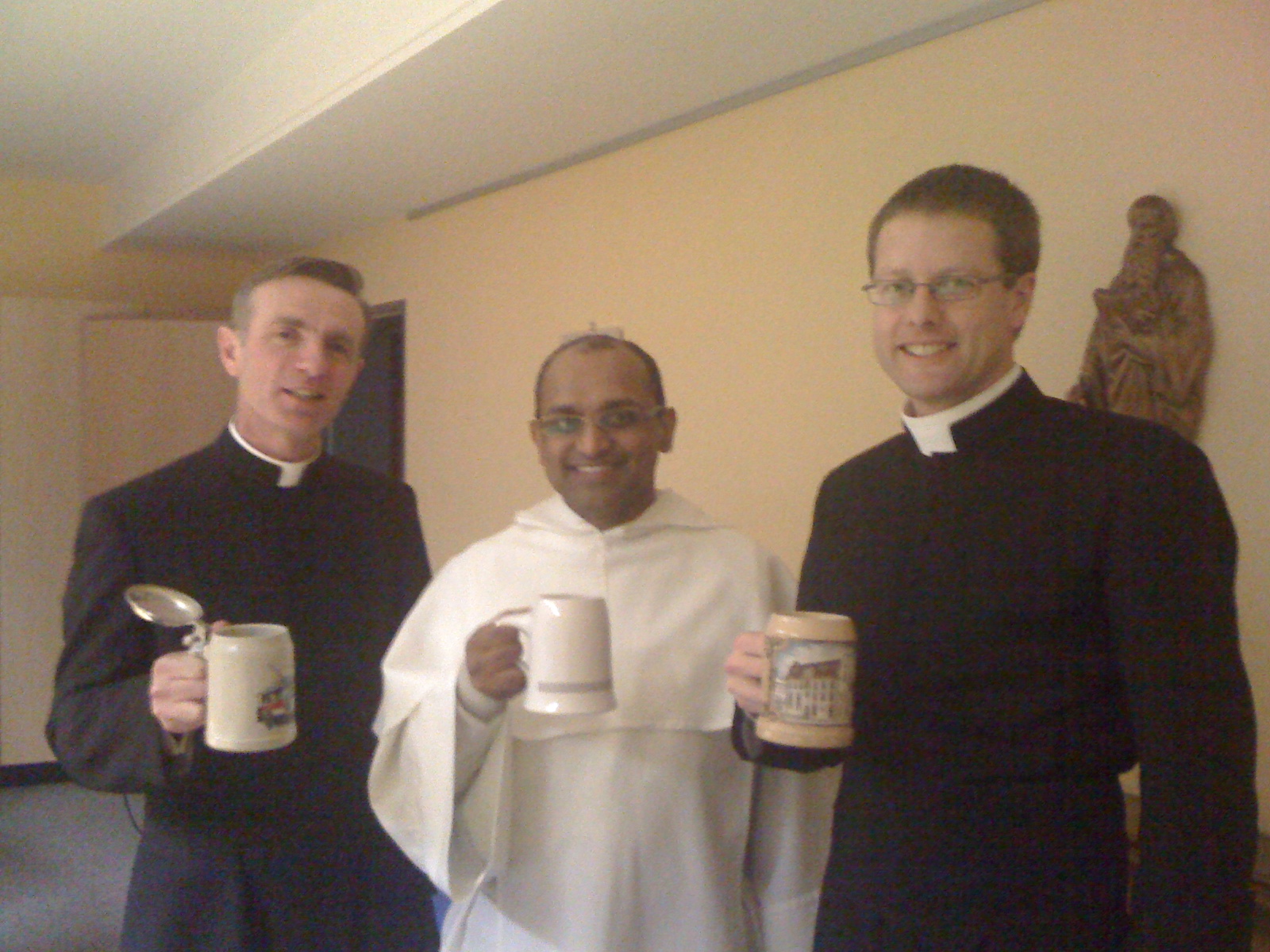
Being in Bavaria - beer is the way to celebrate!


This is the "front" altar (set into the altar steps) in the nearby Benedictine Basilica at Ottobeuren. An ideal arrangement for anyone who wants to bring the altar closer to the people!


And finally, a little reminder of home.
St Catherine Labouré in a window in the Shrine Church at Wigratzbad.

Friday, 10 February 2012

Latin Is Not Dead

The Mass of Pope John XXIII

The interview below was given to the Zenit Newsagency. In the same year that the Second Vatican Council opened, Pope John XXIII also hoped to encourage the study and use of the Latin language. Interesting... What happened to that hope?

Professor Speaks of a Conference to Celebrate Papal Documents Backing Church's Official Language

By Salvatore Cernuzio

ROME, FEB. 9, 2012.- On Feb. 22, 1962, Pope John XXIII signed the apostolic constitution "Veterum Sapientia," on the study and use of Latin, as a result of which he hoped, among other things, that an Academicum Latinitatis Institutum would be created.

The institute was founded later by Pope Paul VI with the apostolic letter "Studia Latinitatis" of Feb. 22, 1964, entrusting the Salesians with the task of "promoting its prosperity."

Half a century later the Pontificium Institutum Altioris Latinitatis is organizing a conference to be held Feb. 23, titled "Veterum Sapientia: History, Culture and Timeliness." The congress will examine some important episodes in the history of the institute and will also consider the challenges today regarding the study of classical languages.

ZENIT spoke with Father Roberto Spataro, a teacher in the Faculty of Christian and Classical Literature of the Pontifical Salesian University, about the forthcoming congress.

ZENIT: Professor Spataro, how did the idea for this conference come about and what are its objectives?

Father Spataro: The congress is being held on the 50th anniversary of the promulgation of a solemn document, the Veterum Sapientia, unfortunately quickly, unjustly forgotten.

We intend to re-visit that document and to show how it is still very timely in proposing the need that in the Church, especially among priests, that the great ethical, spiritual and religious values be known that the ancient world developed and that Christianity perfected, thus constructing the foundations of contemporary civilization.

ZENIT: Many believe that Latin is a "dead language." What is your opinion?

Father Spataro: This is truly an unfortunate expression. I wonder how a language can be defined as dead in which Seneca, St. Augustine, Thomas Aquinas and generations of scientists, from Galvani, inventor of electricity, to Gauss, the "prince of mathematicians," wrote.

How can one hold as "dead" a language that is studied today by so many persons, and nourishes lofty and noble thoughts? Not forgetting that it is the language of the Holy See and that the liturgy in Latin attracts in ever increasing numbers the faithful, many of them young people.

ZENIT: In recent times, instead, it seemed that Latin was dying out: Seminarians did not study it any longer and it was not used in the liturgy. What is your Institute doing about this situation?

Father Spataro: In recent years, tentative beginnings have taken place within the Catholic Church in terms of renewed interest in the study of Latin. Among these are the birth of new religious communities and lay movements that have understood well how a most precious patrimony belongs to the Tradition, to the life itself of the Church, of liturgical, canonical, magisterial, theological expressions whose content is comprehensible only in its linguistic form, namely, Latin. Hence, our Institute wishes to teach a greater number of clerics and lay people to be able to appreciate this patrimony, so that every Church is able to have access to people who love the way in which truth, beauty and harmony are united in this language.

ZENIT: It seems that in many parts of the world there is a renewal of interest in Latin. Is this true?

Father Spataro: It is true! Some time ago, a distinguished German university professor told me that in Germany there are more than 800,000 students in high schools and university institutes who study Latin. In our Institute, for example, we receive students from China, sent by their Universities, because they feel the need to know European civilization and its cultural origins expressed in Latin.

ZENIT: What are the reasons for this renewed interest?

Father Spataro: Talking with professors and students from all over the world, I have come to believe that there is a desire to study Latin so as to access a world, a res publica litterarum, of a very high spiritual level. The present economic and financial crisis is no more serious than the ethical and the anthropological. Young people in so many parts of the world study works written in Latin, from Cicero to Cyprian to Erasmus of Rotterdam, and are tired and disappointed by "bad teachers" of the contemporary age, and want to acquire for themselves pure, true thought. The study of Latin makes it possible to reacquire this "spiritual innocence."

ZENIT: Even in Italian Middle Schools there is a return to the study of Latin.

Father Spataro: Latin is a very pleasing language to learn, with one condition: that the method is abandoned that morbidly reigns in schools, imposed by a German philology beginning in the 19th century. If taught, instead, with methods of the great humanists -- for example, that which was practiced for centuries in the Jesuits' schools, or the "nature-method" taught in 150 hours -- a student, without excessive toil and especially without boredom, is already able to read the classics. There is need of a new generation of teachers that know this method and adopt it enthusiastically because it works miracles!

ZENIT: Are there examples of the success of this method?

Father Spataro: Certainly! An example is the Vivarum Novum Academy, an institution with which our Faculty has collaborated for some time and that operates in Rome. Young people from all over the world go there, for one or two years, to study Latin and Greek. They arrive without knowing a single word of the language of Caesar or Plato and after a few months they are able to speak fluently in Latin, acquiring at the end of the course a true knowledge of the humanistic civilization, that is, of the genuine values of man that come from the Veterum Sapientia.
Thursday, 9 February 2012

Traditional Mass this Sunday


Just a note for anyone who travels here for the 11.30am Extraordinary Form Mass on Sunday and was perhaps not here last week. There will be NO EF MASS this Sunday 12th February. I am away on Sunday and the priest staying here to look after the parish for the weekend is unable to say that Mass. Unfortunately I've not been able to find anyone to offer the EF Mass.

This is a disappointment to me but not actually in the Archdiocese as a whole as there are several priests who can offer the Traditional Form of the Mass but these days they are not the retired priests but clergy with their own parishes and therefore their own Masses to say on a Sunday morning. In fact, there are four parishes where there is a regular Sunday EF Mass in the Archdiocese, and a total of eight where the EF Mass is offered on a weekly basis or on holydays - so we are better off than most.

Mass will be back on as usual after this Sunday.

If there is a priest out there not too far away from Leyland who could help out on a Sunday occasionally, I would be very happy to hear from you!

Sunday, 5 February 2012

First Solemn High Mass at the Shrine of Ss Peter and Paul

For the Feast of the Purification the Shrine Church of Ss Peter and Paul and St Philomena in New Brighton on the Wirral thrilled to the sights and sounds of Solemn High Mass for the first time in many years. Mass was offered at the Lady Chapel as the High altar is not yet in use.The main altar will formally be brought back into use for the Feast of the Annunciation in an "official" opening of the Shrine. With characteristic self-effacement the Rector of the Shrine, Canon Meney, stood aside to assist with the chant while Fr Ian O'Shea of the Archdiocese of Liverpool was celebrant. Fr Francis Wadsworth of Salford Diocese was Deacon and Abbé Cosme Montjean of the Institute was Subdeacon.

Here are some photos, courtesy of Canon Meney. You can see in some of them the poor state of repair of the fabric of the church, which the Institute is working to bring back into good order.

You can request their weekly bulletin by e-mail at: newbrighto​n@icrsp.org

Their regular Sunday Mass is at 11.30am and is easily accessible from the nearby New Brighton rail station. The church is on Atherton Street.


Wednesday, 1 February 2012

When is a Catholic not a Catholic?


Substitute the words "Empty pews and empty altars".
The great revolution that would bring people flowing into the Church as it "opened up"to the world that many hoped after the Council has has indeed left only phantom faces at the window!

"They sang about tomorrow but tomorrow never came."
And yes,
"The very words that they had sung"
(on the hopeful day of so many First Communions)

"Became their last communion."

When is a Catholic not a Catholic? That is to say, just how far removed from the practice of the Church and from any ongoing relationship with the Church do you have to be before it can be said that you are no longer a Catholic? Included in this is the question of whether a person has any prayer life or relationship - daily, weekly, yearly - with the Lord. Of course, it's then said that we must not judge and many such lapsed may be living "good" lives but I think even with the most generous of interpretations, this could not be claimed of the present situation. Those that are lapsed are for the most part gone from prayer, from Christian living and from a Christian world-view - they follow the world on moral values and live their lives according to the norms of their neighbours rather than those of the Gospel.

This comes to mind having read the editorial of this month's "Catholic Voice" - the official newspaper for the Diocese of Lancaster. Brought to my attention by Deacon Nick of Protect the Pope. He says:
It is a response to the questions in Bishop Campbell’s recent pastoral letter that among other things asks,‘Is it time for us to admit that we can no longer maintain schools that are Catholic in name only?’ One of the conclusions the diocesan newspaper makes is that we are maintaining a sacramental and school system that has created 5 million lapsed Catholics.
"Now I know that in bygone times not everyone practised the Faith and came every Sunday but no one in the school or parish - not even those who were lapsed - thought this was alright or acceptable. No one baulked if a teacher told a pupil they should be at Mass on Sunday. No one thought the school should be facilitating this non-practising way of 'practising' the Faith. Facilitating a system that has created five million lapsed Catholics.

There is no sense of urgency or crisis about this lack of practice. It is the same in story in all the dioceses of this country. Someone quoted figures the other day for my own Archdiocese of 450,000 Catholics (in name) and out of this figure 52,000 attend Sunday Mass.

The few who are there at Mass each Sunday cannot continue to provide schools and churches for the many who never come. We close churches because we can't afford to keep them up but the schools are full. Those who want all the treats and benefits but do not contribute financially or spiritually should no more expect the school to be there for them just because they want it any more than they can expect a church building to be there for them just because they suddenly have a funeral or a wedding to arrange. How many generations of not practising do you need to come from before you are no longer a Catholic, even if someone is willing to baptise you despite a proven track record that there is no founded hope of being brought up in the Faith in any meaningful way?

Here is the article as it appears on the Protect the Pope site:
‘The stark fact is that of the Diocese’s 100,000 Catholics,around 80,000 are lapsed from the practice of the faith. To be honest,the word ‘lapsed’ is inaccurate for many because it suggests that these 80,000 once practised the faith though regular participation in the Mass. The truth is that the majority of Catholics come from families who for generations have never practised the faith and only have their children baptised,confirmed and make their First Holy Communion out of social convention. A useful model to understand this is the ‘cycle of deprivation’ that describes how generations of unemployment lead families into intense poverty and an inability to work entrenched and enabled by the welfare state.

In a similar way,the existence of 5 million lapsed Catholics in England and Wales,with only 880,000 practising,reflects the dynamics of a ‘cycle of faith deprivation’ in which there is a generational impoverishment about the faith and a disinclination to practice entrenched and enabled by our parish sacramental system and Catholic schools.

Simply put,we have created a sacramental and educational system that has created a startling 5 million Catholics who have never practised the faith,never had a living relationship with Jesus Christ. The real problem is that this huge group of nominal Catholics have the social convention of presenting their children for the sacraments but with no intention of raising them in the faith because they themselves have no experience of practising the Faith. Furthermore, baptismal certificates are highly sought after by many as passports Catholic schools system. The reality in Lancaster Diocesan schools is:you don’t need any baptism because you get in anyway if you want to!

Canon Law states that children should only receive the sacrament of baptism if there is ‘a well-founded hope that the child will be brought up in the catholic religion’ (Can. 868). Maybe when non-practising families present their children for baptism the Diocese’s clergy think there is a well-founded hope that the children will be brought up in the catholic religion because they have made contact with the parish and will attend Catholic schools in the future. The fact that there are now 80,000 non-practicing Catholics in the diocese suggests that this hope in the majority of cases was not well founded.

The truth of the matter is,as Bishop O’Donoghue put it so well in Fit for Mission? Schools,tens of thousands of children leave the Catholic school system just as lapsed as they were when they entered our schools. Two of the questions we need to ask of the Diocese’s clergy and school Heads and Heads of RE is how many children,and their families,experience conversion to the Faith and engaged with parish life? How many children from practising families lose their faith while attending their schools?

The Catholic Voice of Lancaster has learnt that it is not uncommon for children from practising families to be bullied by other children because they are a such a tiny minority in schools in which the majority of children,and teachers,are either non-practising or non Catholic.Furthermore,it is common experience that young people are so scarce in the parishes that those who do attend can feel out of place and alien,surrounded as they are by mainly grandparents. Bishop Campbell is right to ask the question is it just and honest that 21,000 practicing Catholics support and maintain schools that are Catholic in name only. If these schools are not powerhouses of the Faith,building up those children who have faith,and encouraging conversion in the rest,what is the point of them? If young people are not an essential part of parish life,what will be the future of the parish?

It’s time that the Catholic project of mass education rediscovered its vitality be insisting on a vibrant Catholic ethos in our schools,based on the Four Pillars of the Faith – Creed,Liturgy,Moral Life and prayer,while the connection with the local parishes becomes ever more strengthened,not gradually growing apart .If this doesn’t soon show signs of taking hold in our schools maybe it’s time that the Catholic project of mass education comes to an end.