Wednesday, 2 February 2011

Candlemass

"And thine own soul a sword shall pierce"

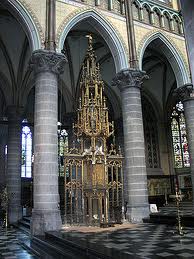
Last year in the south of France I took part in procession for the village feast day - the Sorrows of Our Lady - which is where I took this photograph. I was reminded of this by the Gospel for today's feast of Candlemass. This evening at 7pm we are blessing candles and celebrating Mass (OF - but mostly in Latin and sung propers as well as hymns).

A lovely Feast day as Christmastide finally draws to its close.

Incidentally, here is wider view of the charming little church. Note that Mass is ad orientem.

Monday, 31 January 2011

Genuflections and other gestures - Part. 2.


Father Juan Silvestre, professor of liturgy at the Pontifical University of the Holy Cross and a Consultor of the Congregation for Divine Worship and the Sacraments, as well the Office of Liturgical Celebrations of the Supreme Pontiff, writes on Zenit (in an article reproduced below) about the significance of external signs of devotion. He speaks particularly about kneeling and genuflecting, making the simple and obvious link (although not obvious to everyone) between the outward sign and the inward attitude and how one strengthens the other. Nothing earth-shattering here but I have noticed how often from official and semi-official sources we are now hearing so much along these lines - always linked with copious quotes from the Catechism and from the Holy Father (as Cardinal and Pope).

A friend of mine in Rome recently had the privilege of assisting in the distribution of Holy Communion at St Peter's and it was made abundantly clear that communion must be given on the tongue. Although I notice that not all those assisting in such a way always follow this injunction (and I'm sure it might be difficult if individuals present their hands in a way that they have grown accustomed to in their own parishes).

What does all this point to? That the Holy Father has realised from past experience that legislation - even from the Holy See - is often ignored at a local level. How often have I heard the cry, "Oh, that doesn't apply here". So, along with legislation he is, I think, trying to change the culture - by encouragement and quiet promotion of a more devout way of doing things.

Let us pray that those most in need will allow themselves to be encouraged.
External Signs of Devotion by the Faithful
Genuflecting and Kneeling Reflect Spiritual Attitude

The Catechism of the Catholic Church reads: "In the liturgy of the New Covenant every liturgical action, especially the celebration of the Eucharist and the sacraments, is an encounter between Christ and the Church" (CCC, No. 1097). Hence, the liturgy is the privileged "place" of a Christian's encounter with God and with him whom he sent, Jesus Christ (cf. John 17:3). In this encounter the initiative, as ever, is the Lord, who presents himself in the heart of the Church, risen and glorious. In fact, "if the figure of Christ does not emerge in the liturgy, who is its principle and is really present to make it valid, we would no longer have the Christian liturgy, completely dependent on the Lord and sustained by his creative presence" (Benedict XVI, To the Bishops of Brazil [North 2], April 15, 2010). Christ precedes the assembly that celebrates. He -- who acts inseparably united to the Holy Spirit -- convokes, gathers and instructs it. Because of this, the community -- and the faithful who take part -- "should prepare [...] to encounter [the] Lord and to become 'a people well disposed.'" (CCC, No. 1098). Through the words, actions and symbols that constitute the scheme of every celebration, the Holy Spirit puts the faithful and ministers in living relationship with Christ, Word and Image of the Father, so that they can insert into their own life the meaning of what they hear, contemplate and carry out. Hence, every "sacramental celebration is a meeting of God's children with their Father, in Christ and the Holy Spirit; this meeting takes the form of a dialogue, through actions and words" (CCC, No. 1153). In this meeting, the human aspect is important, as St. Josemaría Escrivá also pointed out: "I don't have one heart to love God and another to love the people of the earth. With the same heart with which I loved my parents and I love my friends, precisely with this same heart I love Christ and the Father and the Holy Spirit and Mary Most Holy. I will never tire of saying it: We must be very human because, otherwise, we cannot even be divine" ("Christ Is Passing By"). This is why filial trust must characterize our encounter with Christ. Without forgetting, however, that "this familiarity also entails a danger: that the sacred we continually encounter becomes a habit for us. Thus, reverential fear is extinguished. Conditioned by all our habits, we no longer perceive the great, new, amazing fact that he himself is present, speaks to us, gives himself to us" (Benedict XVI, Holy Chrism Mass, March 20, 2008). The liturgy, and in a special way the Eucharist, "is the encounter and unification of persons; the Person, however, who comes to meet us and desires to be united to us is the Son of God" (Benedict XVI, To the Roman Curia, Dec. 22, 2005). The individual and the community must be aware of being before him who is thrice Holy. Hence, the necessary attitude is one full of reverence and of a sense of wonder, which gushes from knowing oneself in the presence of the majesty of God. Was this not perhaps what God intended to express when he ordered Moses to take off his sandals before the burning bush? Was not the attitude of Moses and Elias born from a similar awareness, who did not dare to look at God face to face? And did not the Magi show this same disposition of spirit, who "prostrated, adored him"? The different personages of the Gospel who met Jesus -- he who passes, who forgives -- do they not also give us an exemplary model of conduct for our encounters with the Son of the living God? In reality, physical gestures express and promote "the intention and spiritual attitude of the participants" (General Instruction of the Roman Missal, No. 42), and enable one to overcome the danger that snares every Christian: habit. "For us who have always lived with the Christian concept of God and are accustomed to it, the possession of hope, which comes from the real encounter with this God, is almost no longer perceptible" (Benedict XVI, "Spe Salvi," No. 3). Because of this, "a convincing sign of the effectiveness that the Eucharistic catechesis has on the faithful is surely the growth in them of the sense of the mystery of God present among us. This can be verified through specific manifestations of reverence toward the Eucharist, to which the mystagogic way should introduce the faithful" (Benedict XVI, "Sacramentum Caritatis," No. 65). The acts of devotion are understood in an adequate way in this context of encounter with the Lord, which implies union, "unification [that] can only be realized in keeping with the form of adoration" (Benedict XVI, To the Roman Curia, Dec. 22, 2005). We see in the first place genuflection, which is done "by bending the right knee to the ground, signifies adoration, and therefore it is reserved for the Most Blessed Sacrament, as well as for the Holy Cross from the solemn adoration during the liturgical celebration on Good Friday until the beginning of the Easter Vigil." (General Instruction of the Roman Missal, No. 274). The bowing of the head instead means reverence and honor. In the Creed -- except in the solemnity of Christmas and of the Annunciation (Incarnation), in which it is replaced with genuflection -- we carry out this gesture pronouncing the wonderful words: "By the power of the Holy Spirit he became incarnate from the Virgin Mary, and was made man." Finally, we would light to highlight the gesture of kneeling at the moment of the consecration and, where this use is kept, at Communion. They are strong signs, which manifest the awareness of being before someone special. It is Christ, the Son of the living God, and before him we fall on our knees. In kneeling, the spiritual and physical meaning form a unity, because the bodily gesture implies a spiritual meaning and vice versa, the spiritual act calls for a manifestation, an external translation. To kneel before God is not something that "is not very modern"; on the contrary, it corresponds to the truth of our being itself. "One who learns to believe, also learns to kneel, and a faith and a liturgy that no longer knows about kneeling would be unhealthy in a central point. Where this gesture has been lost, we must learn it again, to remain with our prayer in the communion of the Apostles and martyrs, in the communion of the whole cosmos, in the unity with Jesus Christ himself" (J. Ratzinger, Theology of the Liturgy [Opera Omnia 11]. LEV, Vatican City 2010, p. 183).
Sunday, 30 January 2011

Canons Regular of the New Jerusalem

Dom. Daniel with Fraters Alban and John with myself
at a Mass in St John's (now closed) in Allerton Bywater. Christmas 2007


Congratulations to The Canons Regular of the New Jerusalem who have obtained permision from Bishop Bransfield to reside in Charlestown, West Virginia for a period of two years.

Dom. Daniel has been searching for a home for this dedicated little community for some time now. I'm very happy that something tangible has come about for them and pray for their growth.


Frater John and me outside the Lateran Basilica last year.


Some more photos with Dom. Daniel and the Fraters during Mass in 2007
on the Feast of St John the Evangelist,
which concluded with blessing with a relic of St John.


Here is a Youtube clip of Solemn High Mass at St Michael's Abbey (Norbertines), Orange, California - the temporary home of the Canons. (To watch the rest of the Mass just click on the Youtube links after this first part.)

It is worth noting that the beautiful vestments were made by Dom Daniel himself!

Saturday, 29 January 2011

Cardinal Vaughan School

Cardinal Vaughan
The Catholic Encyclopedia says of him: Cardinal Vaughan was a man of strong vitality, and his energies were devoted, with rare singleness of purpose, to one end—the salvation of souls. He loved directness in thought and speech, and had little taste for speculation or analysis. He knew how to win and to hold the allegiance of men, and the touching extracts from his intimate diary which were published after his death showed him to have been a man of exceptional and unsuspected humility.

Would he like the school named in his memory - I think so.


H/T to Linen on the Hedgerow for picking up this article from the Evening Standard on the Cardinal Vaughan School in London. It seems to be the report of a journalist's experience of simply going into the school to see it for himself. It sounds like a good school where they are Catholic and they mean it. A sad contrast with many of our church schools where you are lucky to see a crucifix prominently displayed in a classroom, let alone hear the rosary and Angelus prayed everyday. Catholic "ethos" can be a very vague concept that covers a great deal. An ethos needs to be experienced in practical ways and one of the most basic is surely that we meet together each Sunday at Mass as God's people to worship Him. Whether you call that an ethos, a practical application, or just Catholicism, it's not something that can be said of very many of our Catholic schools.

Frankly, if I went to a parish where EVERY parent of a child in the school was not just coming to Mass but actively involved in the parish I'd be jumping for joy!


I've highlighted the parts I find most interesting. Here is the article:

A little bit more background to the Vaughan affair
Courtesy of the Evening Standard, 26th October 2010 edition.........

Keeping the faith at a Catholic state school
Stephen Robinson
26 Oct 2010


As the deadline for secondary applications looms this week, a row between parents and officials has left one of London's best Catholic state schools without a head
You know you are not inside a bog standard comprehensive when you walk into a Latin lesson at Cardinal Vaughan Memorial School and all the pupils spring respectfully to their feet.
Outside the classrooms, the male teachers and the senior prefects progress along the corridors in academic gowns, as though they are dons floating across an Oxford quad. There is no interest in the staff room in advancing media studies — at this Holland Park comprehensive, it's more classics, science, maths, music, modern languages and a stiff dose of Catholicism.
The honours board hanging above the main staircase proudly records this year's haul of Oxbridge places — 12, one of the highest of any non-private school in the country. Almost every boy and girl goes on from the school to some form of higher education.
Then there is the strong sense of Catholic devotion. The rosary and Angelus are recited every day. At mass, the boys and girls — who are admitted into the sixth form — kneel on the bare floor. They are encouraged, though not compelled, to attend confession. Discipline is strict, though the school is certainly not solemn.
The teachers josh around with the boys and girls in the corridors between lessons but there is no doubt who is in charge. Bad behaviour and slacking at homework are not tolerated. The teachers use unfashionable words such as “punishment”.
“The Vaughan”, as generations of old boys and their parents call it, feels almost like a public school, or perhaps more precisely like an old-fashioned grammar school because the children, though impeccably mannered, do not seem “posh”.
As required by laws governing comprehensive school intakes, the Vaughan admits a mixed band of clever and not very clever children from Catholic primary schools; they are ethnically mixed — there are lots of Poles — and some 40 per cent of the children speak English as an additional language at home.
Yet in its unapologetic commitment to academic achievement, the Vaughan is a little like the grammar school depicted in Alan Bennett's History Boys but with a strong Roman influence and without the flattened vowels and high camp flourishes. “The Pope would absolutely love this school,” says one parent. “It's just a shame that our Catholic hierarchy cannot appreciate its strengths.”
With its stellar A-level results, fantastic Ofsted reports and stunning music, it is no surprise that the Vaughan attracts five or six applicants for every place. Parents love it because it offers an education that would cost upwards of £20,000 a year across the way at St Paul's or Westminster, and it is precisely this level of achievement that has led to a ferocious row over the “gerrymandering” of the school's board of governors.
Last Thursday, this erupted out of the pages of the Tablet and into a potentially ruinously expensive legal battle pitching the Vaughan against the Archbishop of Westminster, Vincent Nichols, and the Westminster Diocese Education Service (WDES). A group of parent governors sent a letter to parents pleading for funds to take the diocese to court to stop what the governors see as a blatant attempt to destroy the Vaughan as one of the very best Catholic comprehensive schools in the country.
The row at the Vaughan reflects a London-wide problem for many of the better church schools, which are heavily oversubscribed, causing tension between church authorities and disappointed parents. The London Oratory, which competes with the Vaughan to be regarded as London's top Catholic state school, turns away scores of disappointed parents each year. The Brompton Oratory, which is linked to the school, records attendance so that sharp-elbowed middle-class parents cannot fool the admissions staff. Nick Clegg, an avowed atheist married to a Spanish Catholic, is said to be considering sending his children there.
The Vaughan has unwittingly become the battleground between liberal and conservative English Catholics in a war to determine what is a proper state-funded Catholic education.
Overwhelmed by applications for its prized places, the Vaughan decided to demand proof of levels of Catholic adherence beyond the diocese's standard requirement that children be baptised Catholics whose parents regularly attend mass.
“We found middle-class parents were good at playing the system, and that parish priests would just sign the form confirming attendance as a favour,” says Sir Adrian Fitzgerald, former chairman of the governors, who was returned to the board by Kensington and Chelsea council. So the Vaughan asked for evidence of parental “involvement” in Catholic affairs as a means of weeding out less devout applicants.
This was regarded as uncontroversial by the parent body but caught the attention of officials at the Westminster diocese. To the fury of parents and staff at the school, the WDES reported the Vaughan to the Government inspectorate for breaching comprehensives' admissions policies.
The diocese argues that demanding higher levels of Catholic commitment discriminates against poor children whose parents are less able to contribute by volunteering at parish events, or cleaning the church. [I find this amazing - I know for a certain fact that parents of poor children are just as capable of giving their time and energies to a parish community as anyone else.]
That one Catholic bureaucratic body should report a Catholic school to a secular schools inspectorate was regarded as a gross betrayal by the Vaughan and by many in the wider London Catholic community.
Worse still, so far as the Vaughan was concerned, the diocese began to use its powers to purge the school board. Six governors deemed supportive of the school were ousted, then the dioceses imposed as a governor Paul Barber, director of WDES, a lawyer who has no direct teaching experience.
Barber was the official who reported the school to the secular schools adjudicator so his appointment to the board caused fury, prompting parent governors to secure a temporary injunction barring his appointment as a conflict of interest.
The upshot is that because of the injunction, the Vaughan's board of governors is unable to meet, and it is impossible to select a replacement for the much-loved headmaster, Michael Gormally, who has retired because of ill health.
Many parents believe the diocese has deliberately paralysed the governing body so that it can impose a liberal outsider on the school as the next headmaster and begin to purge the Vaughan of its conservative Catholicism and unpick its unapologetic academic elitism.
“The diocese clearly wants to change the school,” says Sir Adrian Fitzgerald, an outspoken sixth baronet who divides his time between west London and his ancestral home in Ireland. “Why are they picking on this school when they should be worrying about failing schools in London?” He believes that the officials in WDES are “wagging the dog” and persuading the bishops to impose conventional Left-wing ideology on the schools.
Patti Fordyce, another governor whose term was terminated by the diocese in August, believes the WDES is trying to impose its vision of modish Catholic liturgy suitable for young people, “all tambourines and guitars, all that stuff that is as embarrassing as watching parents dance at a disco”. Fordyce, whose own son attended the Vaughan, says that what children really respond to “is the beauty of the liturgy”.
The Vaughan is clearly at a crossroads, and staff and parents fear that should the diocese prevail in imposing a liberal outsider as headmaster, the best teachers will leave, and the school could simply collapse.
The Westminster diocese refuses to explain why its director of education, Paul Barber, has been appointed to the Vaughan's board. Officials say the row is a matter of “authority” and that it is for the bishops, not school governors, to determine admissions' criteria.
Barber is not, and has never been, a governor of any other school in the diocese, even those which have been placed under watch as “failing”. Parents and staff argue that if entrance criteria became more specifically geographical, it would benefit principally the ultra-rich who live in the multi-million pound houses on Addison Road in Holland Park rather than the wider Catholic community of west London.
At the Vaughan, where the teachers are caught in the crossfire, it is business as usual, though Charles Eynaud, the acting headmaster, concedes the legal dispute is taking its toll.
“We are looking forward to a speedy resolution of this matter so that we can move on and the Vaughan can continue to improve and flourish,” he says, declining to comment further.

---------------------------------------------------------------------------
James Preece has more on this debacle on his excellent site, Catholic&Lovingit.

Friday, 28 January 2011

Registration open for Adoratio Conference


Registration is now open for the major International Conference on Eucharistic Adoration which will take place in Rome from June 20-24, 2011, organised by Mon Dominique Rey, the Bishop of Fréjus-Toulon.


"The Conference is being held with the intention of promoting the desire of the Magisterium of the Catholic Church to see Perpetual Adoration spread to Parishes and Dioceses around the world.

The faithful must seek to receive and to venerate the Most Holy Sacrament with piety and devotion, eager to welcome the Lord Jesus with faith (Pope Benedict XVI May 11, 2007)

Holy Mass is in itself the Church’s greatest act of adoration: “No one eats of this flesh”, as St Augustine writes, “without having first adored it”.
Adoration outside Holy Mass prolongs and intensifies what has taken place in the liturgical celebration and makes a true and profound reception of Christ possible. I would like to take the opportunity to warmly recommend, to Pastors and to all the faithful, the practice of Eucharistic adoration. I express my appreciation to the Institutes of Consecrated Life as well as to the associations and confraternities that are especially dedicated to this practice; they offer to everyone a reminder of Christ’s centrality in our personal and ecclesial life.

In life today, often noisy and dispersive, it is more important than ever to recover the capacity for inner silence and recollection. Eucharistic adoration permits this not only centred on the “I” but more so in the company of that “You” full of love who is Jesus Christ, “the God who is near to us”. (Pope Benedict XVI Angelus 06.10.2007)

In fact, adoration must precede our every activity and programme, that it may render us truly free and that we may be given the criteria for our action. (Pope Benedict XVI Speech October 16, 2006)."

Speakers Include


I've just registered myself - it should be excellent!

Wednesday, 26 January 2011

Organist needed

I'm amazed at the variety of people who find this little blog. The statistics tell me that the majority of readers come from the UK but many also from the USA. France, Canada, Italy, Germany, The Netherlands, Ireland and Australia also feature. Surprising is that Greece, Romania, Russia, the Czech Republic, and Turkey have also featured.

However, this particular post is aimed at those close to home here in Leyland. Our parish is in desperate need of an organist - for we do not have one at the moment and all my efforts and connections have not led anywhere as yet. As you can imagine, without an organist we struggle with much of the music. We're blest to have had visiting organists (of some distinction) for special occasions and we have been blest with a schola and someone to organise them for high days and holidays but a regular organist has eluded us.

The Second Vatican Council in Sacrosanctum Concilium spoke of the organ as the pre-emminent instrument for church music:

In the Latin Church the pipe organ is to be held in high esteem, for it is the traditional musical instrument which adds a wonderful splendor to the Church's ceremonies and powerfully lifts up man's mind to God and to higher things.

I couldn't agree more! So - a heartfelt plea for help. If anyone has any ideas or offers, please do get in touch.

Monday, 24 January 2011

The Significance of Genuflections and the Tabernacle

GOR made an interesting comment after the post on the significance of genuflections and other gestures about how we now mostly acknowledge the presence of the Lord in the tabernacle with a bow rather than a genuflection during Mass. Going with this is the idea that somehow Christ is "more" present in the Blessed Sacrament on the altar than He is in the tabernacle, - a dynamic and a static presence, I think I've heard it called. I cannot see how this can be theologically possible. Those who follow this quirky theology, are then driven to place the tabernacle somewhere less important - away at the side or in another chapel.

Priest trapped between Our Lord behind him in the tabernacle
and in front of him
on the altar


While the instructions do indeed suggest that it is possible to reserve the Blessed Sacrament away from the main altar in a church, I think this really envisages places where a great many people pass through (like Cathedrals and historic churches) and cathedrals (where the bishop's presence represents Christ to us). I've no objection to this - but the documents do say a side chapel - in other words, something like the Blessed Sacrament Chapel in Westminster Cathedral - NOT a pillar or stand away at the side of the main sanctuary. (By the way, these are so often not even practical, as there is usually not enough space on the shelf/table in front of them to use when the Blessed Sacrament is being placed in or taken out of the tabernacle.) Incidentally, there is a tradition of Blessed Sacrament towers at the side of sanctuaries but these are not the plant-pot stands we so often see today.

In other words, it should look like this..

And not like this...
The other drive to side-lining the Lord's presence is that when the priest goes to the other side of the altar and offers Mass "facing the people", he then has his back to the tabernacle - a position I find very uncomfortable and odd. The answer, of course, is not to place the priest front and centre thereby side-lining the Lord but to turn and face him, so that the priest is then at the front of God's people leading them towards Heaven. This means that when he genuflects at Mass towards the transformed elements on the altar, he is not at the same time ignoring the existing consecrated species in the tabernacle.