One of the things he criticises in his priests is the following:
"Flamboyant modes of liturgical vestments and rubrical gestures abound."
Here is HIS LORDSHIP himself in completely non-flamboyant and understated mode, posing for a photograph with a dressed goat and a soldier in 19th century costume.
And here is My Lord Bishop in a gold off-the shoulder number,wearing his pectoral Cross over his cope instead of underneath as laid down in the Ceremonial of Bishops.
And again is His Excellency wearing a purple hat and silk belly-band in an aircraft hangar.
Once more, the Right Reverend Bishop in a very inconspicuous hat and understated collar, bravely flouting the much-loathed rubrics by omitting to wear an amice (contrary to GIRM No. 336) and again wearing his pectoral Cross over his chasuble instead of underneath as laid down in the Ceremonial of Bishops.("The pectoral cross is to be worn under the chasuble, dalmatic, or cope, but over the mozzetta." (CB 61))
And, of course, no man of the people following in the humble footsteps of the Lord is complete without his own coat of arms.
Father Gary Dickson commented on my post about Christmas and Holy Communion and brings up some points that strike me over and over again. I hope he won't mind if I use what he says to bring to light my own thoughts and experiences.
He says:
1. "My long-time irk that where priests are in short supply we rush to replace Holy Mass with 'Services of the Word with Distribution of Holy Communion'. This is a favourite solution in our Deanery. "
Services of the Word to replace Mass are envisaged very strictly for Sundays (NOT weekdays). Pope John Paul II reminded us that where they occurred, there was to be intense prayer for vocations so that priests and the Mass could be provided. Any shortage of priests was NOT to be interpreted as a message from the Holy Spirit encouraging lay-presiding. Such services are meant for MISSIONARY areas where it really is impossible for a priest to get there on a Sunday. I have heard some priests recently rejoicing at the prospect of lay-led services on a Sunday in leiu of Mass taking place just up the road, the distance of a brisk walk or short car journey.
Ironically, when it's Father's day off, true lay-led devotions that could be encouraged: the Rosary, the Office, Divine Mercy, Novenas and, Litanies are rarely suggested, although this is what happened in my previous parish when I was away during the week. Of course, these devotions don't involve a lay person dressing up as a quasi-priest and standing at the altar. To make it completely clear that such sercices are NEVER envisaged for weekdays and even on a Sunday only in very special circumstances with the express permission of the bishop, here is the quote from the Interdicasterial Instruction Ecclesiae de mysterio. (On certain questions regarding the collaboration of the non-ordained faithful in the Sacred ministry of the priest by eight dicastries of the Holy See. August 15th 1997).
Article 7
Sunday Celebrations in the Absence of a Priest 1. In some places in the absence of priests or deacons, non-ordained members of the faithful lead Sunday celebrations. In many instances, much good derives for the local community from this useful and delicate service when it is discharged in accordance with the spirit and the specific norms issued by the competent ecclesiastical authority. A special mandate of the Bishop is necessary for the non-ordained members of the faithful to lead such celebrations. This mandate should contain specific instructions with regard to the term of applicability, the place and conditions in which it is operative, as well as indicate the priest responsible for overseeing these celebrations.
2. It must be clearly understood that such celebrations are temporary solutions and the text used at them must be approved by the competent ecclesiastical authority. The practice of inserting into such celebrations elements proper to the Holy Mass is prohibited. So as to avoid causing error in the minds of the faithful, the use of the eucharistic prayers, even in narrative form, at such celebrations is forbidden. For the same reasons, it should be emphasised for the benefit of those participating, that such celebrations cannot substitute for the eucharistic Sacrifice and that the obligation to attend Mass on Sunday and Holy days is satisfied only by attendance at Holy Mass. In cases where distance or physical conditions are not an obstacle, every effort should be made to encourage and assist the faithful to fulfil this precept.
Which brings me to Fr Gary's next point:
2. "It was my very part-time parish secretary who reminded the meeting that we are obliged to attend Mass on Sundays, not to receive Holy Communion on Sundays."
I find again and again that people's understanding has shifted from the obligation to attend Mass to a right to receive Holy Communion. Firstly, no-one has a right to receive Holy Communion, it is always a profound gift. But we do all have an obligation to attend Mass if we possibly can. If you say this these days you are condemned for being a legalist but this is not so. The attendance at Mass brings a person into community with the living Body of Christ, the Mystical Body which is the Church. Without that actual human contact, our Faith begins to mean nothing. You cannot be a Christian by yourself - where two or three are gathered in my name... This is apart from the fact that it is actually good to recall that we do have a relationship of obedience to God, we owe Him worship. An act of self sacrifice of our time once a week is a reminder that self sacrifice is at the heart of our Faith and something we are asked to imitate.
I increasingly hear of people who receive Holy Communion at home because they can't get to Mass and yet they get to the hairdresser, the day centre, the shops, the family party. They will ask relatives to take them to many outings but when asked say, "I couldn't ask them to take me to Mass - they don't go." My own most extreme experience of this was a man who telephoned the parish wanting to know if I would bring him Holy Communion at home. He hadn't been to Mass for years but while he was on holiday in Malta he'd got chatting to a priest who suggested that he get in touch with his local parish! Sure, he had a game leg but it got him as far as Malta.
We seem to have developed an attitude of selfishness and materialism in that something is only valid if we are getting "something" - in this case, Holy Communion.
Fr Gary also says:
3. "How many folk will fulfil their Sunday obligation on Christmas Day night which is the Sunday Mass, or on Sunday (Boxing day) Morning? And will the folk who do not attend either of these Masses present themselves for Holy Communion next week without a second thought? Do we as priests remind then them that if they did not attend their Sunday Obligation they must go to Confession before receiving again, or presume they are in good faith and leave it at that? I shall be presuming good faith, but somewhat uncomfortably..."
Indeed. The missing of Mass seems to be accounted as nothing for many people and yet I have a suspicion that most people who lapse do so gradually. A missed Sunday here and there; life goes on and practice becomes less and very soon it's not even Christmas and Easter and so another family is lost to the practice of the Faith. I do know that there were only half the number of people at Mass last Sunday in my parish as would usually be. Presumably, attending Mass two days on the run is just too much to ask.
I'm sometimes told by other priests that being at Mass is not the be-all and end-all of everything but surely, being at Mass is also not just nothing. The practice of the Faith isn't just about Sunday Mass but I would want to include much else that goes with it. It is at Mass that people are encouraged to pray every day, to look after those in need, to live a moral life, to judge the world around them with a correct conscience, to pray for others, to learn and defend doctrine, to ponder the Scriptures, to worship the Lord. Or at least, I hope all this is happening at Mass.
I was going to say that I have no answers to these things. Rather, I have no understanding of why people think in these ways. While I personally don't have any answers - as a priest I believe that the Church does but in thinking that, Fr. Gary and myself find ourselves in a minority here in this country - and we try to get on with doing what we're supposed to be doing, as Cardinal Piacenza encourages. (See the post below.)
But we should not despair - we should rejoice to hold firm in the face of adversity. I am reminded of a certain speech:
This story shall the good man teach his son; And Crispin Crispian shall ne'er go by, From this day to the ending of the world, But we in it shall be remember'd; We few, we happy few, we band of brothers; For he to-day that sheds his blood with me Shall be my brother; be he ne'er so vile, This day shall gentle his condition: And gentlemen in England now a-bed Shall think themselves accursed they were not here, And hold their manhoods cheap whiles any speaks That fought with us upon Saint Crispin's day.
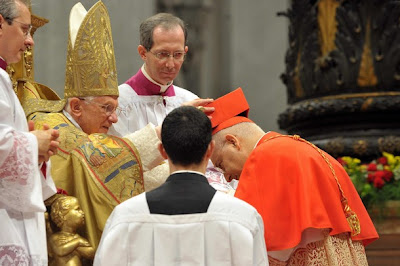
Cardinal Piacenza receiving the red hat in November.
Mauro Cardinal Piacenza, the new Prefect of the Congregation for Clergy, wrote to priests and deacons for Christmas stressing the need to take heart and continue in faithfulness to the message of Christ that will always bear fruit, even when it seems all is lost. I particularly liked his reminder that the Priesthood is ontological, that we go on being who we are, doing our usual duties and these will avail us and others of salvation. As the Church in the Western world shrinks, it is tempting to many to throw themselves into ever more outlandish schemes and compromises with the world but these burn themselves out and cannot last. Nothing is so old-fashioned as the most recent fashion to go out of date. We are called back to our roots and to the business of being holy. The Cardinal says: "The Church has nothing more to do than to go on in her own proper duties, in confidence and peace; to stand still and to see the salvation of God."
Our success cannot be counted in numbers but in souls that are actually led to Heaven. I seem to come across many Catholics who are so in name but hold views diametrically opposed to the teachings of the Church, not just on one issue but in many areas. Others who have little clue of the teaching of the Church or of Our Lord in the Gospels. I'm reminded of the case of the lady who, having heard the late Cardinal O'Connor of New York preaching on the Gospel forbidding divorce took him to task after Mass demanding to know "Who said so?". When the good Cardinal told her that it was Our Lord who said it she replied irately, "Well, he shouldn't have!"
I think the Cardinal reminds us of some excellent points. Here is the article with my own highlights.
Dear Priests and Deacons,
At this time, when the Holy Father has graciously named me as the new Prefect, I would like to take the opportunity to convey a cordial greeting to each and every one of you.
The Year for Priests, recently brought to a conclusion, remains always before us, both in its content and in its model of sanctity, St John Mary Vianney. With regard to its content, it is to be fully assimilated into the environment of the formation of the Clergy, both in the initial and ongoing stages, especially concerning to the central place it wished to recognise of the Eucharist, celebrated and adored; with regard to the model of sanctity that was offered, the heroic participation of the Curé of Ars in the self-giving of Christ for the life of men shines forth, and that witness spurs us continually to offer ourselves to the Lord in the "fragrant sacrifice".
Even in the face of the storm of the "worldly sea," Jesus of Nazareth repeats to his disciples, "Do not be afraid!" To the temptation of activism and of the fitful searching after solutions that are human, and all too human, He beckons us gently, "Remain in my love" (Jn 15: 9).
As the Holy Father Benedict XVI pointed out, "If we continue to read this Gospel passage attentively, we also find a second imperative: "abide", and "observe my commandments". "Observe" only comes second. "Abide" comes first, at the ontological level, namely that we are united with him, he has given himself to us beforehand and has already given us his love, the fruit. It is not we who must produce the abundant fruit; Christianity is not moralism, it is not we who must do all that God expects of the world but we must first of all enter this ontological mystery: God gives himself. His being, his loving, precedes our action and, in the context of his Body, in the context of being in him, being identified with him and ennobled with his Blood, we too can act with Christ" (Allocution at the Pontifical Roman Major Seminary, 12 February 2010).
Dear friends, it is precisely this primacy of the ontological over the ethical, of the "abiding" over the "doing" that is the guarantee, and the only guarantee possible, of the fruitfulness of our apostolate!
In the face of prevailing secularism and rampant relativism, Blessed John Henry Cardinal Newman reminds us that, "Christianity has been too often in what seemed deadly peril, that we should fear for it any new trial now. So far is certain; on the other hand, what is uncertain, and in these great contests commonly is uncertain, and what is commonly a great surprise, when it is witnessed, is the particular mode by which, in the event, Providence rescues and saves His elect inheritance. Sometimes our enemy is turned into a friend; sometimes he is despoiled of that special virulence of evil which was so threatening; sometimes he falls to pieces of himself; sometimes he does just so much as is beneficial, and then is removed. Commonly the Church has nothing more to do than to go on in her own proper duties, in confidence and peace; to stand still and to see the salvation of God" (Biglietto Speech, 12 May 1879).
With these sentiments of profound, radical fidelity to the Lord in the Church and in history, in the Lord of my and of your sacerdotal existence, I ask a particular remembrance in your prayers, while I assure you of my pastoral concern, entrusting each one of you to the powerful protection of Her who, by virtue of a most special title, is the Mother of Priests: the Blessed Virgin Mary.
Fr Z has some timely reminders about going to Holy Communion and our attendance at Mass. Here are some of them.
First, if you are not in the state of grace, don’t just go to Holy Communion anyway. That’s a sacrilege and a mortal sin. Those of you who are lax about Mass attendance need to remember that not going to Holy Mass on Sundays and other days of obligation, when you could go, is a mortal sin. Go to confession and then make your good Holy Communion. We all know the bit about making a perfect act of contrition… maybe you can do that and maybe you can’t. That’s up to you. But God cannot be fooled. If you know you shouldn’t receive then don’t.
Second, if you know you cannot go to Holy Communion that does not mean you are excused from going to Mass. You still have the obligation to attend Mass on Sundays and days of obligation even if you can’t receive. That’s why they are called days of obligation. It is your attendance that is obligatory, not Communion.
Third, observe the Eucharistic Fast, which is one hour before Communion not one hour before the beginning of Mass. If you want to fast longer, fine. One hour is the law, unless you are sick, etc. etc. Remember, to receive Communion we have to be disposed in our souls (by being in the state of grace) and in our bodies (by observation of the fast which pertains to our state in life).
The Parish received its quirennial visitation from the Auxiliary Bishop of Liverpool, Tom Williams, this weekend. He travelled on Sunday morning from Liverpool in temperatures of minus 13. I sat in choro whilst Bishop Tom offered the Ordinary Form Masses. Having changed into his full purple cassock, he then took his turn in choro while I offered the Traditional Rite Mass at 11.30am - he preached at this and all the Masses (thus needing a second sermon to accommodate the differing readings!) Our numbers at Mass were down on the usual because of 6 inches of snow and freezing conditions but at least the church was nice and warm - and we didn't need to huddle around the ample charcoals in the thurible for warmth!
Regarding the use of the 1962 liturgical books the Pimpernel and I are of one mind:
"Our first response ought to be one of obedience, a traditional hallmark of Catholics to the rulings of competent authority in all things but sin. We may like the third confiteor or folded chasubles and the broad stole, and even rightly argue that they are elements of the Tradition which should not be lost, but it is not a matter of sin not to use them."
Among those availing themselves of the Holy Father's generosity in Summorum Pontificum it is not unusual to find many who have inserted elements from previous Missals. A priest friend once had a server who insisted on making the third confiteor, only slighty sotto voce, even though none of the other servers were saying it and the absolution was not being given!
I've added this site to the blogbar on the right in order that new entries will be flagged. I for one look forward to reading the musings of the Liturgical Pimpernel. Ad Multos Annos!
Full, conscious and actual participation does not mean people clamouring to take part in the performance of the rites, rather, they are fully to participate in the Paschal Mystery they signify.